Subsidies available for EVs and charging stations in 2026
24 February 2026
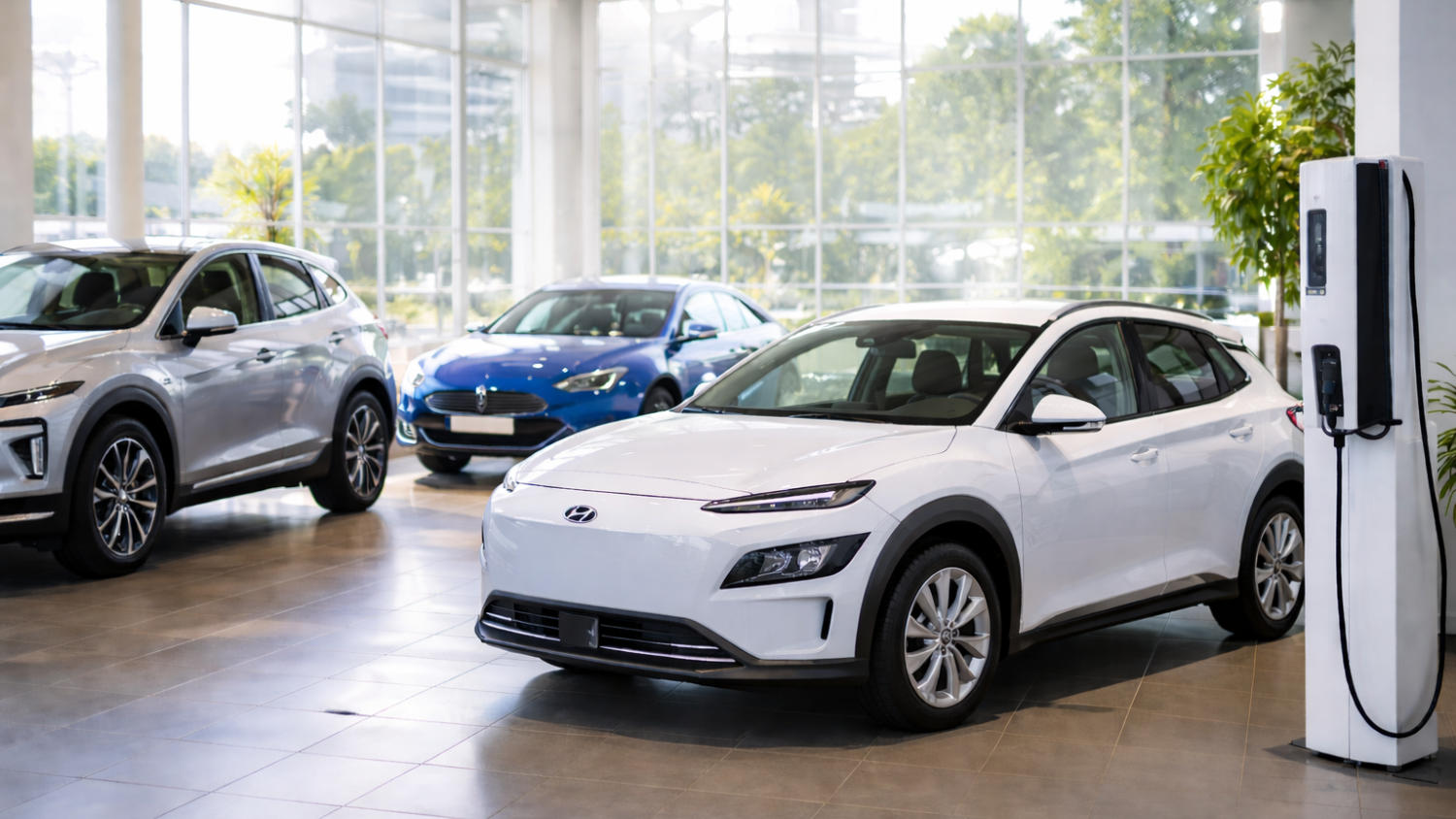
In 2026, the financial assistance ecosystem for electric vehicles (EVs) in Quebec and Canada is both generous and in transition. Some programs are winding down, others are starting up, and many can be combined (federal + provincial + sometimes municipal/energy companies). The purpose of this article is to simplify your life by presenting all the subsidies available for EVs in 2026.
Main federal and provincial subsidies for 2026
Federal: the EVAP program
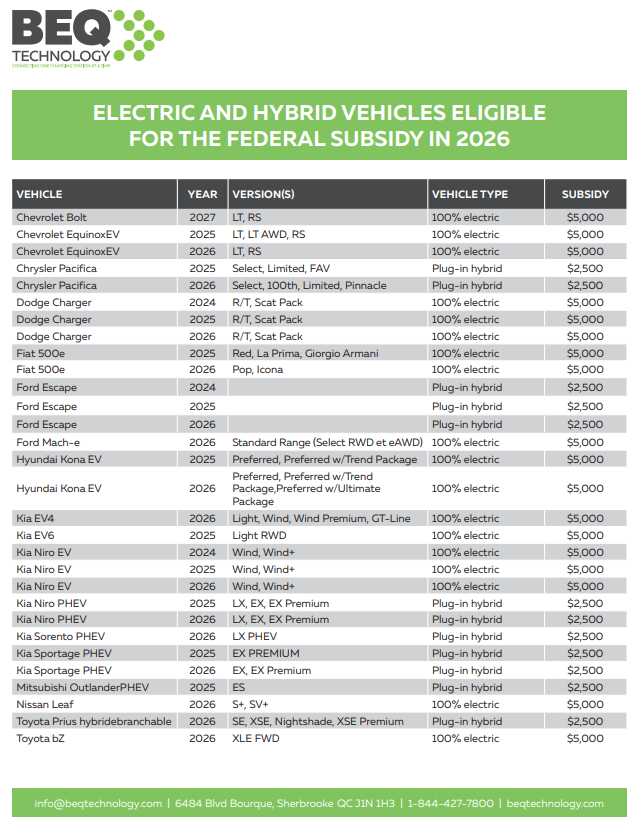
In February 2026, Ottawa launched the Electric Vehicle Affordability Program (EVAP), which offers incentives of up to $5,000 (battery/hydrogen EVs) or up to $2,500 (plug-in hybrids) under certain conditions. It targets transactions with a final value not exceeding $50,000, with an announced exception for EVs manufactured in Canada (no final transaction value limit). The program applies to Canadian individuals and businesses, and many EV models are eligible. These include the Chevrolet Bolt, Hyundai Kona, and Mustang Mach-e, to name a few!
Keep in mind: the EVAP also provides for a submission portal (starting March 31, 2026, for eligible purchases/leases as of February 16, 2026).
In Quebec : End of the Roulez Vert program
In Quebec, you have less than a year left to take advantage of the provincial Roulez Vert program, as it ends on December 31, 2026. However, this program is still worthwhile if you want to benefit from it!
In 2026, Roulez Vert will still offer financial assistance, but it will be reduced compared to previous years. You can get up to $2,000 for a new EV, up to $1,000 for a used EV or plug-in hybrid vehicle, and $600 for a home charging station.
Subsidies for individuals – purchase or lease of an EV
Federal incentive (EVAP)
EVAP is the flagship federal assistance program in 2026 for the purchase/lease of eligible light-duty EVs. Through this program, you could receive:
- Up to $5,000: battery or hydrogen EVs
- Up to $2,500: plug-in hybrids
In short, this program is designed for “affordable” EVs with a final value of less than $50,000.
Helpful tip: Before signing on the dotted line, check that the model is on the program’s official list (updated by Transport Canada), as certain requirements/exclusions may apply.
Please note that this list is subject to change and may vary without notice.
Provincial subsidy (Quebec – Roulez Vert)
As explained at the beginning of this article, the Roulez Vert program will remain active in 2026, but will officially end on December 31, 2026. This program is very attractive because it covers electric vehicles (new, used, and hybrid) as well as charging stations. In addition, the amount allocated for the purchase and installation of a charging station has not decreased, unlike the other amounts. You can therefore obtain a $600 subsidy until December 31, 2026. Take advantage of it!
Useful information: If you ordered an EV in May 2025 and receive it in May 2026, the amount of the subsidy will be based on the date of registration and not on the date the vehicle was ordered.
Can provincial and federal subsidies be combined?
Yes: the federal government indicates that provincial/territorial incentives may be combined with the federal incentive, according to the rules in effect.
An individual in Quebec can therefore aim to combine the EVAP + Roulez Vert subsidies, if the vehicle is eligible for both and if the transaction rules are followed.
Subsidies for businesses
When we talk about “commercial,” we need to distinguish between two main categories:
1 – Light vehicles (cars/SUVs used by the company, sales representatives, etc.)
2 – Medium and heavy vehicles (trucks, heavy vans, shuttles, heavier delivery vehicles, etc.)
Businesses: light vehicles (cars/SUVs)
- The PAVE program is also available to Canadian businesses (not just individuals!) for the purchase or eligible lease of light EVs.
- In Quebec, the Roulez Vert program also allows businesses to benefit from the subsidy, particularly through its “connected at work” component.
Typical case: an SMB that replaces three employee vehicles with eligible EVs can seek cumulative assistance and then add charging assistance.
Businesses: medium- and heavy-duty vehicles (trucks, shuttles, etc.) – iVMLZE (federal)
For fleets electrifying heavier vehicles, Ottawa maintains a separate program, the Incentive Program for Zero-Emission Medium- and Heavy-Duty Vehicles (iVMLZE).
- It can offer incentives of up to $200,000 per eligible vehicle, at the point of sale, for purchase or lease (12 months or more).
- It is explicitly aimed at businesses and organizations and applies to the “medium and heavy” categories.
Quebec: Electrification of Heavy Fleets – Écocamionnage
In Quebec, the Écocamionnage program supports the technological modernization of road freight transport to reduce GHG emissions.
Reference sources on fleet electrification indicate that heavy-duty electric/plug-in hybrid vehicles may be eligible for very high amounts (e.g., up to $175,000, with possible bonuses depending on the case).
Fleet strategy: compare iVMLZE (federal) vs. Quebec programs (e.g., Écocamionnage) based on:
- exact vehicle type (class/GVW),
- delivery schedule,
- cumulative conditions,
- and company eligibility.
Subsidies for charging stations (residential + multi-unit housing + workplace + fleets)
An electric vehicle without a charging station is a bit of a problem! Fortunately, there are structured assistance programs in Quebec and Canada to help individuals and businesses install charging stations.
Quebec – residential charging station
Quebec offers $600 for the purchase and installation of a home charging station (Roulez vert program).
Québec – multi-unit dwellings (condos, apartment buildings, etc.)
Quebec has a specific program for the installation of charging stations in multi-unit dwellings, intended for owners or residents depending on the project setup, with eligible expenses including purchase/rental and installation/planning work.
Québec – workplace (businesses, municipalities, organizations)
For charging stations at work, financial assistance covers 50% of eligible expenses, up to $5,000 per connector (or per wireless charging station).
This is a very concrete incentive for a company that is electrifying its fleet (or wants to offer charging to employees), because an “office” station reduces charging anxiety and stabilizes costs.
Canada (federal): charging infrastructure and fleets
The federal PIVEZ (Zero Emission Vehicle Infrastructure Program) funds the deployment of charging stations and terminals, including installation in public places, on streets, in workplaces, in multi-residential buildings, and to support fleets.
Important: PIVEZ often operates through calls for projects and contribution agreements, so timing and the quality of the application (site, power, access, justification) are extremely important.

AN ELECTRIC AND ECONOMIC TRANSITION
In 2026, subsidies for electric vehicles in Quebec and Canada will reach a turning point. The programs still exist, but they are evolving, becoming more restrictive, and requiring more rigorous planning than before. For individuals, this is the perfect opportunity to take advantage of provincial assistance combined with the new federal program. For businesses, especially those looking to electrify a fleet, the incentives can represent major savings.
Electrification is no longer just an environmental issue: it is now a strategic, financial, and operational decision. Between purchasing the vehicle, installing charging stations, and optimizing available incentives, every detail counts.
One thing is certain: if you plan to go electric this year, there are ways to save money on both the vehicle and the charging station!